
In Nigeria, a DNA test is often crucial in resolving paternity and inheritance disputes. However, the power of a court to order DNA testing is subject to constitutional safeguards and judicial discretion.
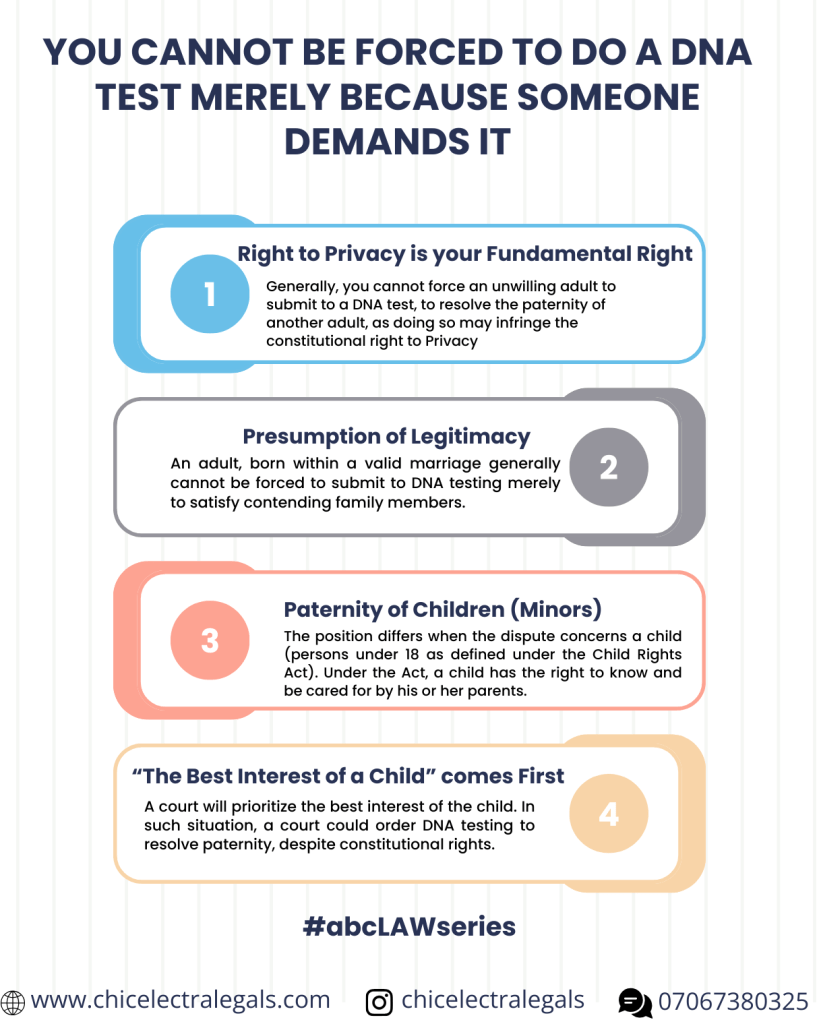
Generally, a Nigerian court cannot physically force an unwilling adult to submit to a DNA test, as doing so may infringe on the constitutional right to privacy under Section 37 of the Constitution of the Federal Republic of Nigeria 1999 (as amended). Courts must balance this right against the interest of justice.
However, the import of the above infers differently in distinct scenarios as analyzed as follows:
PATERNITY OF ADULTS
Where the issue concerns an adult, whose paternity is being challenged:
- In Nigeria, a child born during the subsistence of a valid marriage (or within 280 days after its dissolution, provided the mother has not remarried) is presumed legitimate.
- This presumption of legitimacy is strong and can only be rebutted by cogent and compelling evidence.
- Mere allegations of infidelity are insufficient to displace this presumption.
- Where an adult refuses to undergo DNA testing, the court will not typically order physical compulsion.
Thus, an adult born within a valid marriage generally cannot be forced to submit to DNA testing merely to satisfy contending family members.
PATERNITY OF CHILDREN (MINORS)
The position differs when the dispute concerns a child (a person under 18 years as defined under the Child Rights Act):
- Under the Child Rights Act, a child has the right to know and be cared for by his or her parents.
- Nigerian courts prioritize the best interest of the child.
- In such cases, courts are more willing to order DNA testing to resolve paternity.
In the end, Courts have the discretion to order DNA testing where justice demands it, particularly in paternity disputes. However, such discretion must be exercised cautiously and in line with constitutional rights.