

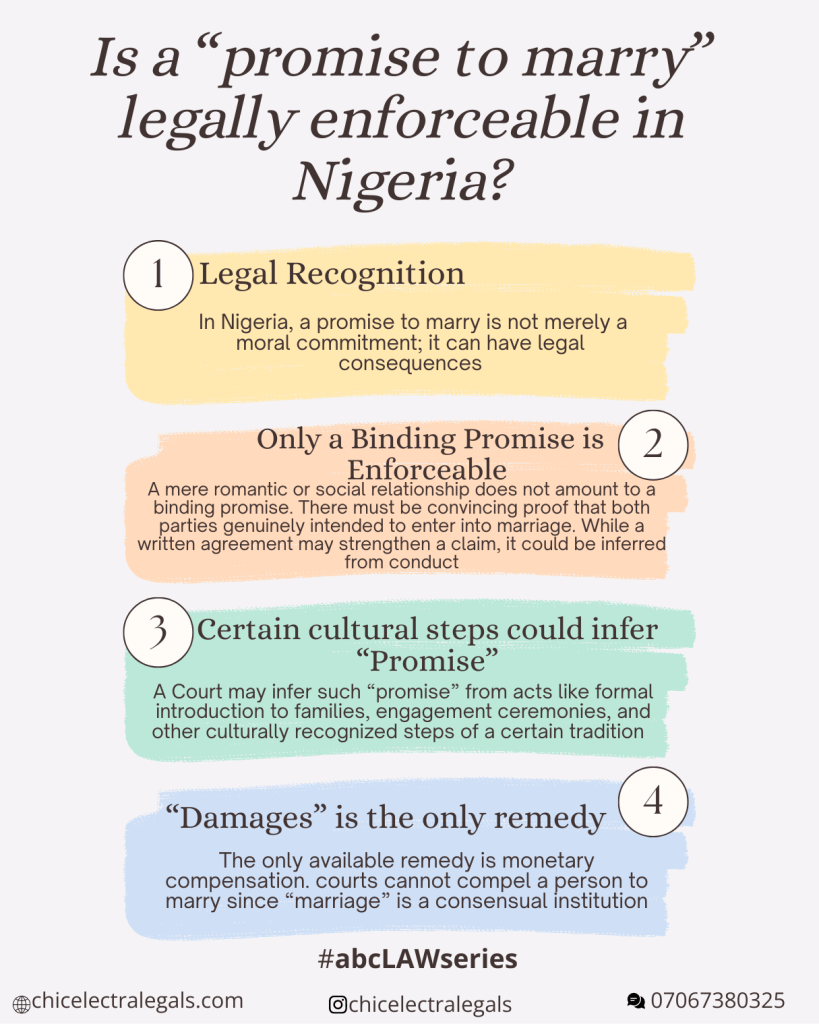
In Nigeria, a promise to marry is not merely a moral commitment; it can have legal consequences. The Supreme Court affirmed this position in Ezeanah v. Atta, where it examined what constitutes a valid agreement to marry and when a breach becomes actionable.
Legal Recognition of a Promise to Marry
Nigerian law recognizes an agreement to marry under different legal systems, including statutory marriage governed by the Matrimonial Causes Act, Islamic law, and customary law. However, because marriage is regarded as a sacred and serious institution, courts require clear proof of intention before treating a promise as legally binding.
The Apex Court made it clear that a mere romantic or social relationship does not amount to a binding promise. There must be convincing evidence that both parties genuinely intended to enter into marriage. While a written agreement may strengthen a claim, it is not always required. A Court may infer intention from conduct, such as formal introduction to families, engagement ceremonies, payment of bride price under customary law, or other culturally recognized steps toward.
Note that the proof required may differ depending on the type of marriage contemplated. Statutory and Islamic marriages, which have defined legal formalities, often require stricter proof than customary marriages, which depend largely on local customs and practices.
When Is Breach Actionable?
For a claim of breach of promise to marry to succeed, two elements must be established:
- A clear and definite promise to marry.
- A refusal or failure by the other party to honour that promise.
If these elements are proved, the injured party may claim damages. However, courts cannot compel a person to marry. The only available remedy is monetary compensation for losses suffered, which may include emotional distress, reputational harm, and financial expenses incurred in preparation for the intended marriage.
End Note
Although legally recognized, breach of promise to marry claims are rare and carefully scrutinized. Courts avoid turning ordinary romantic relationships into enforceable contracts. Strong, credible evidence is required before liability will be imposed.
In the end, Nigerian law acknowledges that a promise to marry can create legal obligations. However, only clear, intentional, and provable agreements will ground a successful action for breach.