

Many years ago, there is a famous story about a man who married another woman in Lagos while still being in a subsisting customary marriage in Kano. When the truth emerged during an inheritance dispute, the later marriage was declared void because the earlier marriage still existed.
In Nigeria, Marriage is regarded as a sacred institution. However, Nigerian law recognizes that some marriages, although celebrated with ceremonies and witnesses, may not be valid in the eyes of the law. In such cases, the parties may appear married socially but remain legally single.
Under the Matrimonial Causes Act (MCA), certain circumstances render a marriage void ab initio—meaning the marriage is treated as though it never existed in law.
Below are five instances where this can occur.
When One Party Is Already Married
A marriage is void where either party is already lawfully married to another person at the time of the ceremony. This is the classic case of bigamy.
For example, if a man contracts a statutory marriage while a previous valid marriage still exists, the second marriage is void from the beginning.
In such a situation, despite the wedding ceremony and years of cohabitation, the parties are legally considered never to have been married.
When the Parties Are Too Closely Related
The law prohibits marriages between people within certain degrees of consanguinity or affinity, such as between siblings or close blood relatives.
Where parties fall within these prohibited degrees, the marriage is automatically void. In legal terms, their marriage never existed.
The reason behind this is both moral and genetic. The law seeks to protect family structures and prevent socially unacceptable unions.
When the Marriage Ceremony Is Not Legally Valid
A statutory marriage must comply with certain legal formalities. If these formalities are not followed, the marriage may be invalid.
For instance, marriages must generally be celebrated in a licensed place of worship or registry, unless a special license authorizes otherwise. Failure to comply with these formal requirements may render the marriage void.
Thus, a wedding ceremony conducted outside the legally recognized framework may create the appearance of marriage but not a legally valid union.
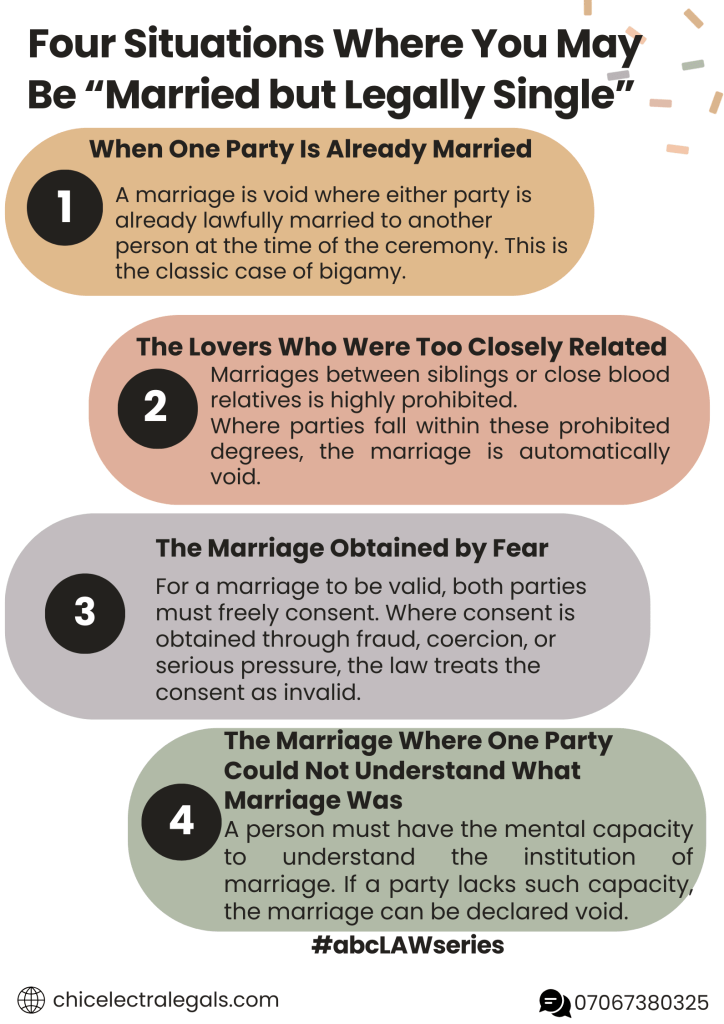
When Consent Was Obtained by Fraud or Duress
For a marriage to be valid, both parties must freely consent. Where consent is obtained through fraud, coercion, or serious pressure, the law treats the consent as invalid.
For example, Miss A agreed to marry Mr. B after intense pressure from her family. On the wedding day, she privately told a friend that she felt she had no choice but to go through with it.
Later, she could approach a court claiming that her consent was obtained through duress and intimidation.
If the court finds that consent was not genuine, the marriage may be declared void.
When a Party Lacked the Capacity to Understand the Marriage
Under Nigerian law, a person must have the mental capacity to understand the nature of the marriage contract. If a party lacks such capacity at the time of the ceremony, the marriage can be declared void.
In such cases, the law protects vulnerable individuals by refusing to recognize the marriage as legally valid.
End Note
A wedding ceremony alone does not always create a valid marriage. Under the Law, Matrimonial, a marriage may be void from the outset if it involves bigamy, prohibited relationships or lack of mental capacity etc.
In these situations, the parties may appear married socially, yet legally they remain single, since the law treats the marriage as though it never existed.